
Insight Blog
Agility’s perspectives on transforming the employee's experience throughout remote transformation using connected enterprise tools.
18 minutes reading time
(3507 words)
Predictable Profit in Uncertain Markets: How Smart Businesses Build Stable Revenue

Predictable Profit in Uncertain Markets: How Smart Businesses Build Stable Revenue
Learn how smart businesses build predictable profit and stable revenue, even in uncertain markets, using clarity, systems, and repeatable execution.
Predictable Profit in Uncertain Markets: How Smart Businesses Build Stable Revenue

From our point of view—running a business right now feels unpredictable.
Markets shift overnight, customer expectations change without warning, and what worked last year can stop working tomorrow.
This isn't just a feeling, either.
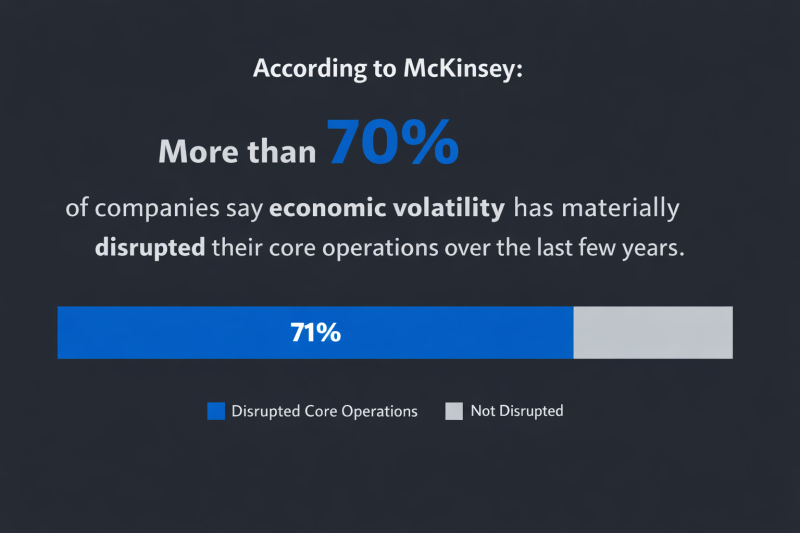
According to McKinsey, more than 70% of companies say economic volatility has materially disrupted their core operations over the last few years.
In other words, instability isn't a temporary phase. It's the environment we're operating in.
But here's the part most leaders get wrong: uncertainty doesn't automatically lead to unstable results.
Some businesses continue to generate predictable profits even while competitors struggle. They're not smarter, luckier, or more aggressive. They're simply more intentional.
As management thinker Peter Drucker famously put it, "The best way to predict the future is to create it."
The companies that thrive in volatile markets take this seriously. They design their operations, decision-making, and systems so performance doesn't collapse the moment conditions change.
This idea is echoed in modern research too.
The best way to predict the future is to create it.
Peter Drucker
McKinsey & Company notes that businesses with strong operational clarity and repeatable processes are significantly more likely to outperform peers during periods of disruption.
Not because they avoid risk—but because they manage it deliberately.
This isn't another "survive the storm" theory piece.
It's a practical look at how smart businesses build stable revenue when conditions are messy—by focusing on clarity, consistency, and execution instead of chasing short-term wins.
What Predictable Profits Actually Mean (And What They Don't)

What Predictable Profits Actually Mean (And What They Don't)
Let's clear something up right away: predictable profits do not mean guaranteed revenue.
No business, no matter how mature, can control the market completely. Customers change. Costs rise. Unexpected events happen. Anyone promising certainty is selling fiction.
What predictable profits really mean is control. Control over how revenue is generated, how costs behave, and how accurately you can forecast what's coming next. It's about reducing surprises, not eliminating risk.
Businesses with predictable profits focus on consistency.
They know which activities reliably lead to revenue and which ones don't.
They can look ahead weeks or months with reasonable confidence because their numbers aren't driven by last-minute deals or one-off wins. Forecasts aren't perfect—but they're close enough to plan hiring, investments, and growth without crossing fingers.
This is where controllable growth levers matter. Instead of hoping demand appears, these businesses understand what actually moves the needle—retention, repeat usage, operational efficiency, and execution quality.
When they want to grow, they pull levers they understand rather than gambling on momentum.
It's also important to separate growth spikes from sustainable revenue.
A big sales month feels great, but if it can't be repeated, it's noise—not progress. Predictable profits come from revenue that shows up again and again, even when conditions aren't ideal.
That's what allows leaders to make calm decisions instead of constantly reacting to the latest numbers.
In short, predictable profits aren't about playing it safe. They're about building a business that performs reliably—even when the market doesn't.
Read this article: : Top 6 AI-Powered Project Management Tools To Use In 2023
Why Predictable Profit Matters
Predictable profit isn't just a nice-to-have—it's essential for strategic growth. In unpredictable markets, businesses that rely on sporadic sales spikes or fleeting trends are constantly at risk.
Cash flow becomes inconsistent, operational planning grows challenging, and decision-making becomes reactive. Predictable profit, by contrast, allows companies to plan with confidence, reinvest strategically, and scale sustainably.
For example, vending operations offer an illustrative lesson.
Each machine contributes to the bottom line, but locations, product selection, and maintenance all influence outcomes.
By analyzing historical performance and focusing on metrics that drive steady returns, operators can understand what contributes to average vending machine profit.
This clarity allows them to replicate success across new machines and locations, ensuring revenue stability even when broader market conditions fluctuate.
Businesses that pursue predictable profit are better positioned to:
- Make informed investment decisions without overextending resources
- Maintain operational stability even during economic downturns
- Scale strategically by knowing which systems can handle growth
- Foster long-term customer relationships built on consistency
Why Most Businesses Struggle to Maintain Predictable Profits
Most businesses don't struggle because they're badly run.
They struggle because they're stuck reacting.
When revenue starts wobbling, the first instinct is usually to push harder on sales—more outreach, more discounts, more urgency. Short-term tactics might bring in a quick win, but they rarely create predictable profits.
They create spikes followed by dry spells, which makes planning harder and stress levels higher.
Another big issue is fragmented systems.
Data lives in too many places—one tool for sales, another for operations, another for internal communication. The result?

Leaders don't get a clear, real-time view of what's actually happening. Decisions are made on partial information, outdated reports, or gut feeling instead of facts.
That lack of visibility feeds reactive decision-making.
When numbers dip, teams panic.
Budgets get frozen, priorities shift overnight, and people start chasing symptoms instead of fixing root causes. Fear replaces strategy, and consistency disappears.
Finally, many businesses simply don't have repeatable processes. Success depends on a few key people knowing what to do, rather than on systems anyone can follow.
That works when things are calm—but in uncertain markets, it breaks fast.
Without repeatable execution, profits will always feel unpredictable, no matter how good the product or team is.
The 4 Main Core Pillars of Stable Revenue in Uncertain Markets

The 4 Main Core Pillars of Stable Revenue in Uncertain Markets
When markets are unpredictable, stability doesn't come from bold moves—it comes from boring fundamentals done well.
Businesses that maintain predictable profits tend to rely on the same core pillars, even if they operate in very different industries.
Operational clarity and visibility
If you can't clearly see what's happening inside your business, you can't control outcomes.
Simple as that.
Teams waste time guessing where work stands, leaders rely on lagging reports, and problems surface only after revenue is already impacted.
Businesses with stable revenue make performance visible in real time—who's doing what, what's blocked, and where things are slipping.
Clarity removes panic. When everyone sees the same picture, decisions get calmer and faster.
Customer retention over constant acquisition
Chasing new customers all the time is expensive and unpredictable.
Retention, on the other hand, compounds.
Businesses that focus on keeping customers engaged, supported, and successful don't have to restart the revenue engine every month.
Repeat customers smooth out cash flow, improve forecasting, and reduce pressure on sales teams. In uncertain markets, retention isn't just cheaper—it's safer.
Process-driven execution instead of heroics
Many businesses run on individual effort.
A few high performers save the day, fix mistakes, and pull late nights to hit targets.
That works until it doesn't. In volatile conditions, heroics burn out fast.
Stable businesses rely on processes that work even when people are stretched or circumstances change.
When execution is repeatable, results become repeatable too—and that's where predictable profits start to show up.
Data-informed planning and forecasting
Guessing feels faster than measuring, but it costs more in the long run.
Businesses that stay profitable during uncertainty don't wait for perfect data—but they don't ignore it either.
They track the right signals, review them regularly, and adjust early instead of reacting late.
Forecasts won't always be exact, but they'll be good enough to plan hiring, investments, and growth without gambling the business.
Read this article: : Top 6 AI-Powered Project Management Tools To Use In 2023
How These Pillars Show Up in Real Companies
These pillars aren't theory.
You can see them clearly when you look at how well-run businesses actually operate day to day—especially during uncertain periods.
- Operational clarity and visibility usually show up as fewer surprises. In real companies, this means leadership doesn't wait until month-end to find out something went wrong. Teams know their priorities, progress is visible, and issues are flagged early. For example, instead of chasing updates across emails and meetings, managers can see project status, workloads, and blockers in one place. When uncertainty hits, these businesses don't panic because they already know where they stand.
- Customer retention over constant acquisition shows up in how companies allocate time and resources. Stable businesses invest just as much effort in existing customers as they do in winning new ones. They actively track usage, engagement, and satisfaction, and they step in early when signals drop. In practice, this might mean customer-facing teams collaborating closely with support and operations so problems don't slip through the cracks. Retention becomes intentional, not accidental—and revenue becomes more predictable as a result.
- Process-driven execution instead of heroics is easy to spot once you know what to look for. In resilient companies, success doesn't depend on one person remembering to do the right thing. Onboarding follows the same steps every time. Requests flow through defined paths. Approvals don't stall because someone is on holiday. When markets get noisy, these companies don't slow down because the work doesn't live in people's heads—it lives in shared systems and documented workflows.
- Data-informed planning and forecasting shows up as calm decision-making. Rather than reacting to gut feelings or isolated metrics, leaders look at consistent signals: engagement trends, delivery timelines, capacity, and output. They don't need perfect data—they need reliable indicators. That allows them to make small adjustments early instead of big corrections later. Forecasts become planning tools, not guesswork.
This is where digital workplace and operational platforms quietly play a role.
Not as "another tool," but as the connective tissue between people, processes, and information. When communication, work, and insight live in one place, these pillars reinforce each other naturally.
Visibility improves, processes stick, teams stay aligned, and leaders gain confidence in their numbers.
And that confidence is what turns uncertainty into something manageable—rather than something that constantly threatens profitability.
How Smart Businesses Reduce Risk Without Killing Growth

How Smart Businesses Reduce Risk Without Killing Growth
One of the biggest myths in business is that reducing risk means slowing down. In reality, the opposite is usually true.
The companies that keep growing during uncertain times aren't reckless—but they're not frozen either. They reduce risk by making growth more controlled, not more cautious.
Standardising workflows and decision paths is often the first shift. Smart businesses don't reinvent the wheel every time a decision needs to be made.
They define how common scenarios are handled—what gets approved, who owns it, and what "good" looks like. This removes friction and hesitation. When people know the path forward, work keeps moving even when conditions change.
Building resilience into operations comes next. That means designing systems that don't collapse when something goes wrong. Key knowledge isn't locked in one person's head.
Processes don't depend on perfect conditions. Teams can absorb disruptions—staff changes, delays, demand swings—without everything grinding to a halt. Resilience isn't about avoiding problems; it's about recovering quickly when they happen.
Creating feedback loops between teams is another quiet but powerful move. In many businesses, departments operate in silos, so issues surface late—usually when revenue is already affected.
Smarter organisations create regular, lightweight ways for teams to share what they're seeing. Sales flags patterns early. Operations highlights bottlenecks.
Support feeds real customer signals back into the business. This keeps small problems from becoming expensive ones.
Finally, planning for downside scenarios without freezing innovation is what separates resilient businesses from fearful ones.
Smart leaders acknowledge that not every bet will pay off—but they don't stop experimenting. Instead, they set boundaries. They test ideas on a smaller scale, track results closely, and adjust fast.
Growth continues, but it's measured, intentional, and recoverable if things don't go as planned.
Reducing risk isn't about playing defence. It's about creating enough structure and visibility that growth can continue—even when the market doesn't cooperate.
The Role of Systems, Tools, and Alignment
A lot of uncertainty in business doesn't come from the market—it comes from inside the organisation. Specifically, from tools that don't talk to each other and teams that aren't aligned around the same information.
When systems are disconnected, uncertainty creeps in everywhere. Data lives in silos. Updates get lost in email threads. Teams work off different versions of the truth.
Leaders think things are on track until they're not. By the time problems surface, revenue has already taken a hit. That kind of setup makes predictable profits almost impossible, because decisions are always made a step behind reality.
Unified platforms change that dynamic.
When communication, work, and information live in one place, execution becomes more stable. People don't waste time hunting for context or duplicating effort. Priorities are clearer. Progress is easier to track.
Most importantly, when something starts to slip, it's visible early—while there's still time to fix it. Stability doesn't come from working harder; it comes from removing friction.
Real-time insight plays a big role here.
Businesses that perform well during uncertainty don't wait for quarterly reports to understand what's happening.
They keep an eye on leading indicators—team engagement, delivery progress, workload balance, and follow-through. When engagement drops or bottlenecks appear, they act quickly instead of guessing why results changed weeks later.
This is where digital workplace and operational platforms quietly earn their keep. Not as shiny new tools, but as alignment engines.
They bring people, processes, and performance into the same view, so execution doesn't depend on memory, manual updates, or guesswork. When everyone is working from the same source of truth, decisions get calmer, coordination improves, and revenue becomes far easier to predict.
The goal isn't more software. It's fewer blind spots. And fewer blind spots mean fewer surprises—especially the expensive ones.
Real-World Examples: How Predictable Profits Show Up in Real Companies
Predictable profits don't come from secret tactics.
They come from repeatable behaviours you can clearly see in well-run organisations. Here's how that looks in practice.
Amazon — Measuring What Actually Matters
Amazon is a classic example of a company that doesn't obsess over vanity metrics.
Instead, it focuses relentlessly on leading indicators—signals that tell them how the business will perform before revenue shows up or drops off.
Internally, Amazon tracks operational metrics like delivery reliability, system availability, customer friction points, and process efficiency. Leaders know what "normal" looks like, so when something shifts—even slightly—it's investigated early.
That's how problems get fixed before they snowball into customer churn or margin erosion.
This discipline is a big reason Amazon can operate at massive scale while still maintaining predictable profits.
Decisions aren't driven by instinct or lagging reports—they're driven by clear, shared signals that reflect real business health.
Intuit — Reviewing Performance Without Panic
Intuit (the company behind QuickBooks and TurboTax) is known for its operating cadence.
Teams don't wait for quarterly surprises to react. Performance is reviewed regularly, calmly, and consistently.
Instead of scrambling when numbers dip, leaders and teams already expect to review what's working and what isn't.
That rhythm removes fear from performance discussions.
Issues surface early, while there's still time to adjust direction, reallocate effort, or improve execution.
This approach keeps decision-making steady even when external conditions change.
Because reviews are routine—not reactive—Intuit can adapt without overcorrecting, which is essential for maintaining predictable profits in uncertain markets.
Atlassian — Prioritising Clarity and Adoption Before Growth
Atlassian has grown quickly, but it's never treated growth as an excuse for chaos.
One of its defining traits is investing in clarity before scale—clear ownership, documented workflows, and shared ways of working.
Just as importantly, Atlassian focuses heavily on adoption, not just rollout.
New systems, tools, or processes aren't considered "done" when they're launched. They're considered successful only when teams actually use them consistently. Friction is removed, habits are reinforced, and unnecessary complexity is stripped out.
That focus on clarity and adoption prevents execution from breaking as the company grows.
When work flows reliably and people know how things get done, revenue becomes easier to forecast—and profits become more predictable.
These companies operate in very different markets, but the pattern is the same:
- They measure signals that matter
- They review performance calmly and consistently
- They build clarity before chasing growth
- They care more about adoption than announcements
None of this is flashy. That's the point. Predictable profits don't come from dramatic moves—they come from businesses that quietly, consistently do the basics well, even when the market isn't cooperating.
Predictive Planning: Anticipating Market Shifts
Markets are inherently unpredictable, but businesses that succeed are those that anticipate trends rather than wait for them to appear.
Predictive planning involves analyzing historical data, identifying patterns, and creating flexible strategies that can adapt to change.
For example, vending machine operators can use sales history to forecast demand for different products. Seasonal patterns, school calendars, or local events can influence traffic and purchasing behavior.
By preparing stock in advance and adjusting placement strategies, operators maintain stable average vending machine profit even when external conditions fluctuate.
Predictive planning also applies to broader business strategies.
Companies that maintain contingency plans, cash reserves, and operational flexibility can navigate market shocks without compromising profitability.
Building Resilience in People and Culture
Predictable profit isn't just about systems and processes—it's also about people.
Businesses that thrive under volatility cultivate a culture of accountability, adaptability, and continuous improvement.
Employees who understand their roles, are empowered to make decisions, and embrace operational discipline contribute directly to revenue stability.
In vending operations, this could mean training staff on efficient restocking, preventive maintenance, and customer interaction.
A culture that emphasizes consistency and problem-solving ensures that every machine contributes reliably to average vending machine profit, reinforcing the business's overall predictability.
The Compounding Effect of Predictable Profit
The true power of predictable profit is compounding. When systems, people, and strategies are aligned, even modest, steady earnings grow over time into significant wealth.
For vending operators, machines that consistently deliver average vending machine profit multiply as networks expand and operations scale efficiently.
Each incremental improvement—better product selection, optimized routes, improved maintenance—adds to stability and long-term profitability.
Over time, predictable profit allows businesses to reinvest with confidence, innovate safely, and scale without exposing themselves to unnecessary risk.
Unlike fleeting wins, which create volatility and stress, consistent profit compounds into lasting financial security.
Common Mistakes That Destroy Profit Predictability
Most businesses don't lose predictable profits overnight. They slowly undermine them through a handful of very common mistakes—usually made with good intentions.
Chasing every opportunity is one of the biggest.
When markets feel unstable, it's tempting to say yes to everything: new segments, custom work, one-off deals, side projects that "might turn into something." The problem is focus gets diluted fast.
Teams stretch themselves thin, processes break, and execution quality drops. Revenue might increase temporarily, but predictability disappears because nothing is repeatable anymore.
Another quiet killer is ignoring internal inefficiencies.
Many leaders look outward for answers—new marketing tactics, new tools, new pricing—while real profit leaks are happening inside the business.
Manual workarounds, unclear ownership, duplicated effort, and slow approvals quietly erode margins and consistency. When inefficiencies are tolerated, revenue becomes harder to forecast because output depends on how much friction teams can absorb that month.
Scaling before stabilising is where things often unravel completely.
Growth exposes cracks. If workflows are messy, data is unreliable, or teams aren't aligned, adding more customers or volume doesn't fix the problem—it multiplies it.
Businesses that rush to scale without stabilising execution first often see revenue grow while profits swing wildly. From the outside it looks like success; internally it feels chaotic and fragile.
Finally, many businesses make the mistake of treating uncertainty as temporary. They assume things will "go back to normal" and delay structural changes.
But uncertainty isn't a passing phase anymore—it's the baseline.
Companies that wait for calm conditions before improving systems, clarity, or processes stay stuck in reactive mode. The ones that accept uncertainty as permanent build for it—and that's what protects predictable profits long term.
The takeaway is simple: profit predictability isn't usually lost because of the market. It's lost because of decisions that introduce unnecessary chaos into how the business operates.
Conclusion: Predictable Profits Are Built, Not Hoped For
Uncertainty isn't the real threat to most businesses.
The real problem is operating without structure while hoping conditions improve. Markets will always shift. Costs will fluctuate. Customer behaviour will keep evolving. That part is out of your control.
What is in your control is how your business responds.
Companies that achieve predictable profits don't try to outguess the market.
They focus on building systems that hold up when conditions aren't perfect.
They invest in visibility so problems surface early. They prioritise consistency over short-term spikes. And they create ways of working that don't rely on heroics, luck, or last-minute fixes.
This isn't about playing it safe or slowing down. It's about creating a business that can move forward with confidence—even when things feel uncertain.
When structure replaces guesswork, leaders make better decisions. Teams execute more reliably. And profits stop feeling like a surprise, good or bad.
Predictable profits aren't the result of optimism. They're the outcome of deliberate design.
Most Popular Posts

Effective communication among team members is vital for the productivity and success of any organization. Surprisingly, 60% of companies lack a long-term internal communication strategy, which p...


Businesses thrive on communication for efficiency, productivity and accomplishment. When the right information is passed from the right designation in the organization, it promotes positivity an...
Categories
Blog
(2726)
Business Management
(333)
Employee Engagement
(213)
Digital Transformation
(185)
Growth
(124)
Intranets
(121)
Remote Work
(61)
Sales
(48)
Collaboration
(43)
Culture
(29)
Project management
(29)
Customer Experience
(26)
Knowledge Management
(21)
Leadership
(20)
Comparisons
(8)
News
(1)

Related Posts

Intranet has brought a revolution to the way we share information. With an Intranet, a group of people can have easy access to the same data simultaneously without being at the same place. Intranet refers to an Internet network that is constructed us...

Here's the uncomfortable truth: most internal communication teams are incredibly busy… but not always effective. Messages go out. Newsletters get sent. Town halls happen. Intranet posts are published. But when you step back and ask, "Did this a...

Live streaming is a valuable tool for businesses, corporations, influencers, and content creators to build a real-time connection with their audience. You can interact with your audience while promoting brands and services. Your audience can comment ...

The Work from Anywhere Movement has exploded in popularity over the last decade. In today's office, remote and hybrid teams are as widespread as printers and water coolers. With Global Workplace Analytics showing a 173 percent increase in the o...

Featured
Let's be honest for a second. Most internal communication problems don't exist because employees "don't pay attention" or because managers aren't sending enough updates. That's the lazy explanation. The real issue is structural — and it's...


Jill Romford
I am a digital nomad, lover of exploring new places and making friends.
I love to travel and I love the internet. I take pictures of my travels and share them on the internet using Instagram.
Traveler, entrepreneur, and community builder. I share my insights on digital marketing and social media while inspiring you to live your fullest life.
Ready to learn more? 👍
One platform to optimize, manage and track all of your teams. Your new digital workplace is a click away. 🚀
Free for 14 days, no credit card required.